
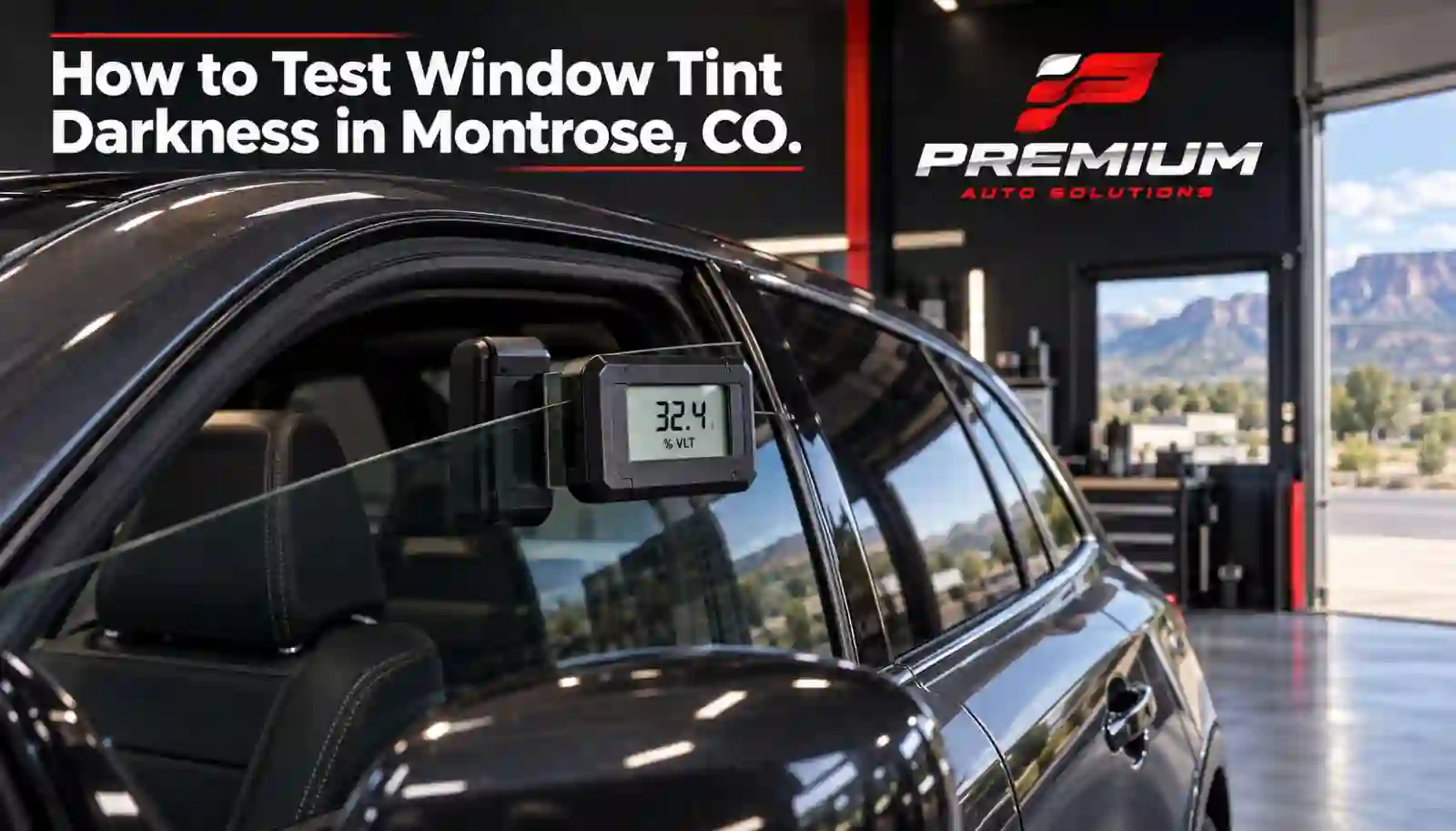
A tint that looks fine in a parking lot can still fail a roadside check. Testing window tint darkness the right way means measuring visible light transmission, not eyeballing it. Drivers ask Premium Auto Solutions about window tint darkness in Montrose every week.
What Window Tint Darkness (VLT) Really Means
Window tint darkness is measured as VLT, or visible light transmission. It is the percentage of light that passes through the glass and film combined. VLT is not the percentage blocked.
A 35% VLT reading means 35% of light gets through. The other 65% is blocked. A 5% VLT reading, often called limo tint, lets almost no light through.
Lower numbers always mean darker glass. Officers and tint shops use this single number to judge legality, and most confusion starts here. A film box lists a rating that is not the final number a meter will show.
Film VLT vs Installed VLT: Why Readings Differ From the Label
A roll of film marked 35% was tested against open air, not against a car window. Once installed, that film sits on top of factory glass. Factory glass already blocks some light.
Untinted automotive glass typically transmits around 75% to 80% of visible light before any film touches it. Stacking a 35% film over 80% glass produces a combined reading closer to 28%. That number comes from multiplying the two percentages together.
This gap is why two cars with the same film box can test differently. Windshield glass, privacy glass, and aftermarket glass all start from a different baseline. The film rating alone never tells the full story.
How Professional Tint Meters Test Window Darkness
A professional tint meter is a two-piece device. One half holds a light source, and the other holds a sensor. The unit clamps onto the window edge and reads through both pieces of glass at once.
The reading reflects the true combined VLT of the glass plus any film. That is the number that matters for compliance. Technicians at Premium Auto Solutions check every finished tint job with a calibrated meter before handing the keys back.
Most professional meters read across the visible light spectrum. They also average several points on the glass. This removes the guesswork that comes from glare or a single spot check.
How to Check Window Tint Darkness Without a Meter
Not everyone has a professional meter on hand. Many drivers look for a way to check tint darkness without buying one. Two common at-home approaches exist, and both have real limits.
Smartphone Tint Meter Apps
Several apps claim to estimate VLT using a phone’s camera or light sensor. These apps can give a rough ballpark. Phone cameras adjust exposure automatically and are not calibrated instruments.
Results from the same window can shift by ten percentage points between attempts. The angle, the app, and the ambient light all change the outcome. Treat any app reading as a starting estimate, never as proof of legal compliance.
Simple At-Home Light and Paper Tests
A basic home test uses a printed page or a light source held behind the glass. The tester judges how much detail is still visible through the window. Some drivers compare the tinted window against an untinted one for reference.
This method only separates obviously legal tint from obviously illegal tint. It cannot tell 25% from 30%. That narrow range is exactly what decides a citation under Colorado’s 27% rule.
Why Visual Guessing Gets Tint Darkness Wrong
Human eyes adapt to light constantly. This makes two different tint percentages look nearly identical in the wrong conditions. A 20% film in bright midday sun can look lighter than a 35% film viewed at dusk.
Camera photos make this worse. Phone screens and lighting change how dark tint looks in pictures shared online. Montrose drivers often bring in a car they believe is legal, only to find the meter reading falls short.
Technicians at Premium Auto Solutions see this mismatch often, especially on vehicles tinted years ago by a different installer. Another common case is a used car bought out of state. A meter reading settles the question in seconds, where a visual guess cannot.
Comparing Ways to Test Window Tint Darkness
| Method | Accuracy | Confirms Legal Compliance | Best For |
| Professional tint meter | High, typically within a few percentage points | Yes | Pre-install checks, compliance, used-car purchases |
| Smartphone app | Low to moderate, varies by device | No | Rough estimate only |
| At-home visual or paper test | Low | No | Spotting obviously illegal tint |
| Comparing against a known sample | Low to moderate | No | General reference, not a legal reading |
A meter reading only matters once you match it to a target percentage. Picking the right VLT for each window is what keeps a reading legal on every side of the car.
Colorado Window Tint Laws and VLT Limits Explained
Colorado sets a 27% minimum VLT for front side, rear side, and rear windows. The windshield requires at least 70% VLT. A nonreflective strip is allowed only on the top four inches.
Rear windows may go darker than 27% under one condition. The windshield and front side windows must both test at 70% VLT or higher. Reflective, mirrored, or metallic finishes are not permitted on any window.
These figures come from Colorado Revised Statutes § 42-4-227. Colorado’s full window tint law breakdown covers the full breakdown, including penalties for each violation type.

Does Factory Tinted Glass Count Toward the Legal Limit
Factory privacy glass on rear windows is manufactured darker than front glass. It often starts well below 27% VLT straight from the factory. That factory tint counts toward the total reading, since the law measures finished glass, not just aftermarket film.
Adding film over factory privacy glass is legal on rear windows. This holds as long as the front side windows and windshield still meet the 27% and 70% minimums. On front doors, factory glass is close to clear, so any added film quickly drops the combined reading.
This is why a meter check matters more on front windows than rear ones. A small miscalculation on the front doors is far more likely to trigger a citation.
What Can Throw Off a Tint Meter Reading
A few conditions can skew even a professional reading. Wet glass, static cling film, and old security film can all lower a reading by a few points. Dirt or road grime on the window has the same effect.
Extreme cold can affect film flexibility after installation, so most shops wait for a short cure period first. Stacking two layers of film, such as aftermarket tint over an existing dealer tint, is not legal in Colorado. That combination also reads far below either film’s individual rating.
A clean, dry, fully cured window gives the most reliable number. This is one more reason a shop check outperforms a quick home test taken under random conditions.
Should You Test Your Own Tint or Book a Professional Check
A quick app or paper test works fine for a general gut check before a road trip. It does not work for confirming compliance before an inspection or a sale. It also falls short near a known trouble spot like a state line.
A professional check makes the most sense after buying a used vehicle with existing tint. It also matters after a DIY film job, or anytime a citation is possible. A quick verification puts real numbers behind a home install instead of a guess.
A five-minute meter check at a shop costs far less than a fix-it ticket. It also costs less than a full film removal and redo.
What Colorado’s Statute Actually Says
Colorado’s tint statute does not include a general medical exemption, despite what some articles claim. A physician’s note does not authorize tint darker than the statutory limit on its own.
Driving with noncompliant tint is a class B traffic infraction. Installing or applying material that violates the standard is a class A traffic infraction. The codified text of Colorado Revised Statutes § 42-4-227 is available for drivers who want to read the source directly.
Conclusion
Testing window tint darkness comes down to one number, VLT, and one truth. A meter reading beats a guess every time. Apps and home tests rule out obviously illegal tint, but only a meter confirms the true combined reading.
Montrose drivers with a used vehicle, an old DIY job, or a new install all benefit from the same step. Premium Auto Solutions checks every window with a professional meter on-site, before or after any film goes on.
Frequently Asked Questions
Can I check my window tint darkness without buying a meter?
Yes, with limits. Apps and paper tests can flag obviously illegal tint, but they cannot reliably confirm a reading near Colorado’s 27% line. A shop meter check is the only way to get an exact, defensible number, and most readings take only a few minutes from start to finish at any Montrose shop.
How does a professional tint meter actually work?
It uses a light source on one side of the glass and a sensor on the other, measuring how much light passes through both pieces at once. The two halves clamp onto the window edge and read the combined glass-and-film VLT in seconds, with no calculation needed from the driver or technician.
Is a window tint percentage app accurate?
Not reliably. Phone cameras auto-adjust exposure and are not calibrated for light transmission, so readings can swing ten percentage points or more between attempts on the same window. Apps work as a rough guide only, never as proof of compliance at a roadside stop or inspection.
Why do two windows both labeled 35% tint look different?
The 35% rating applies to the film alone, tested without glass. Once installed over factory glass, which already blocks 20% to 25% of light, the true combined reading usually lands closer to 25% to 28%, noticeably lower than the film’s printed label on the retail box or sample roll.
Does factory tinted glass count toward Colorado’s legal tint limit?
Yes. Colorado’s law measures the finished window, including factory privacy glass plus any added film, not the film alone. Factory rear glass often starts well below 27% before any aftermarket film is applied, so a meter check still matters even on a car with no new tint installed.
What is the legal window tint limit in Montrose, Colorado?
Front side, rear side, and rear windows need at least 27% VLT under Colorado Revised Statutes § 42-4-227. The windshield requires at least 70% VLT, with a nonreflective strip allowed on the top four inches only, and Colorado’s statute includes no general medical exemption for darker tint.