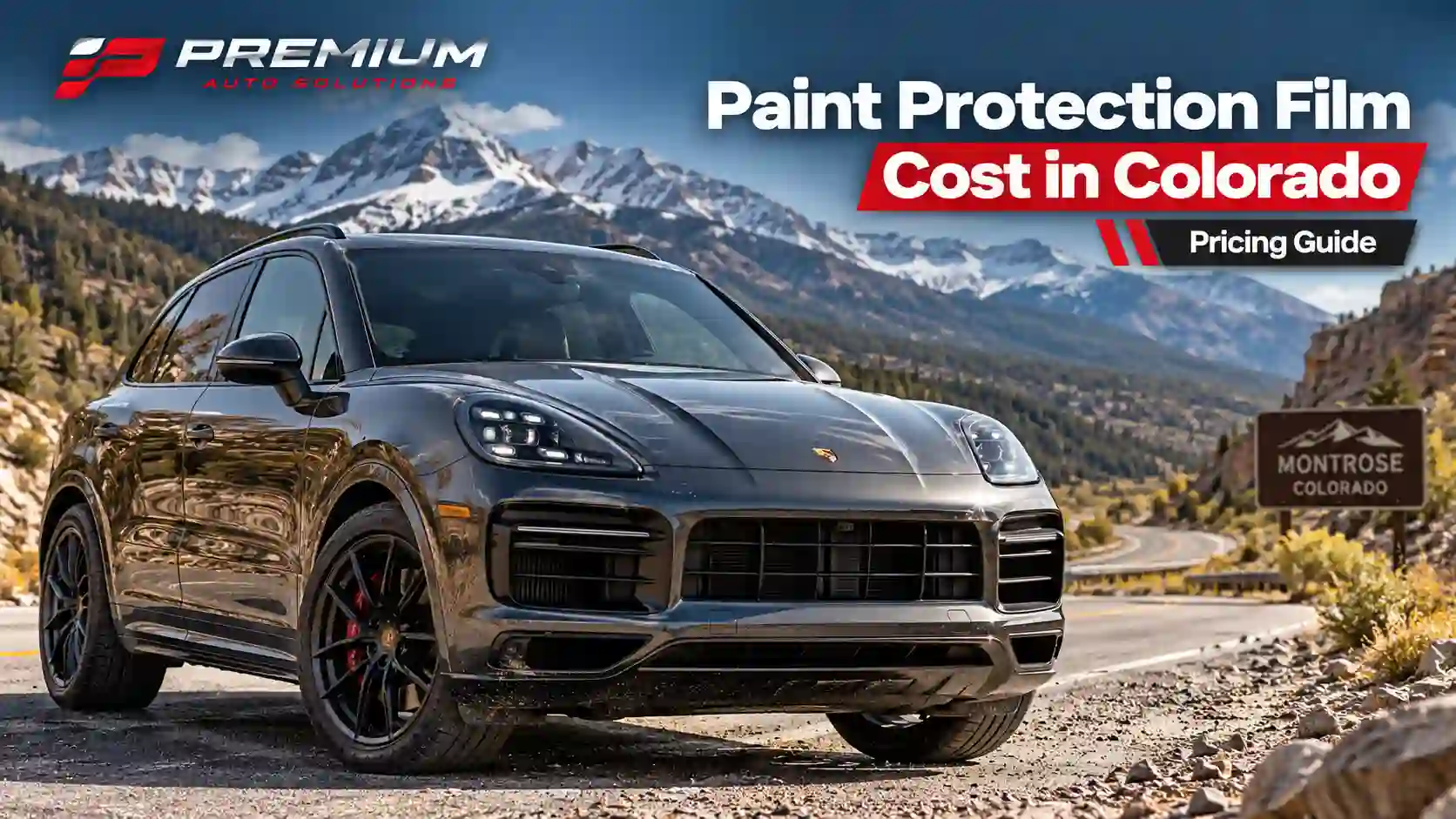
Paint protection film cost in Colorado typically starts around $1,500 for a partial front package. Full-vehicle coverage runs past $7,000. The exact cost depends on vehicle size, film brand, and how much of the car you cover.
Montrose drivers face Highway 550 gravel, high-altitude sun, and winter road treatment. That means faster paint damage than most states see. Premium Auto Solutions installs paint protection film across Montrose, Telluride, Ouray, and Grand Junction. This guide breaks down 2026 pricing by package, what changes a quote, and how PPF costs compare to skipping it.
Key Takeaways
- Partial front PPF starts around $1,500 in Colorado; full-vehicle coverage runs $7,000 or more.
- Vehicle size, film brand, and coverage level drive most of the price difference between quotes.
- Colorado’s altitude, gravel roads, and winter road treatment make PPF work harder here than in milder climates.
- A $1,500 to $2,500 front package typically costs less than a single repainted panel.
- Bundling PPF with ceramic coating through a hybrid package costs less than buying both separately.
- Quality film carries a 10-year warranty against yellowing and cracking, but not against rock chips and road debris.
How Much Does Paint Protection Film Cost in Colorado in 2026?
Paint protection film pricing scales with coverage, not a flat per-vehicle rate. A partial front package on a sedan costs far less than full-vehicle film on a three-row SUV.
Montrose installations are priced as follows:
| Package | Coverage | Starting Price |
| Partial Front | Partial hood, partial fenders, front bumper, headlights | $1,500 |
| Full Front | Full hood, full fenders, bumper, mirrors, headlights | $2,500 |
| Full Front Plus | Full Front, plus A-pillars, roof edge, rocker panels | $3,000 |
| Hybrid Package | Full Front PPF plus full-vehicle ceramic coating | $3,600 |
| Full Vehicle | All exposed painted surfaces | $7,000 |
Statewide, Colorado installers price similarly. Partial front packages generally run $1,200 to $2,500. Full front coverage typically runs $2,200 to $4,500. Full-vehicle film runs $5,500 to $9,000 or more, depending on the shop, film brand, and vehicle size. Larger trucks and SUVs push toward the top of every range, and so do exotic or curved body panels.
What Determines Your Paint Protection Film Price in Colorado
Four factors move a PPF quote up or down more than anything else. Premium Auto Solutions prices jobs by panel and package, not a flat rate. A compact sedan and a full-size truck on the same package rarely cost the same.
Vehicle Size and Body Style
A two-door coupe needs less film and less labor than a crew-cab truck or three-row SUV. Panel count, hood length, and fender width all add to the film’s square footage.
Film Brand and Quality Tier
3M and XPEL film cost more per square foot than off-brand or budget rolls. They carry longer manufacturer warranties and hold up better against yellowing and edge lifting. A quote well under market average usually means thinner, unproven film.
Coverage Level and Installation Complexity
Partial coverage on flat panels installs faster than full-vehicle wraps around mirrors and door handles. Complex curves and tight trim work add labor hours, and more labor hours means more cost.
Installer Experience and Labor Time
A full front package typically takes a full day. Full-vehicle coverage runs two to three days. Technician certification and shop reputation affect both price and install quality.
What Different Vehicle Types Typically Pay
A compact sedan or coupe getting a full front package usually lands near the low end. That range runs roughly $2,200 to $4,500, since the car has less surface to cover. A midsize SUV or crew-cab truck sits closer to the middle or high end. Longer panels and complex wheel-well contours add to that. Three-row SUVs, full-size trucks, and exotic vehicles push toward the top of every package tier. Full Front Plus or full-vehicle coverage often makes sense for these larger, curvier vehicles.
PPF Packages and Coverage Levels Explained
Coverage levels exist because most Colorado drivers do not need full-vehicle film. Their biggest paint problem is usually rock chips on the front end. Owners weighing the spend should see the full breakdown of whether PPF is worth it for new cars in Colorado. It covers the ROI math in more depth.
Partial Front Package
Partial front coverage protects the highest-impact zones only: the front bumper, part of the hood, and part of the fenders. This is the most affordable entry point, and it suits daily commuters who mostly stick to paved routes.
Full Front Package
Full front coverage extends film across the entire hood and fenders, plus mirrors and headlights. It protects the whole nose of the vehicle, not just the strike zone. This is the most popular package for drivers with regular highway or mountain-road miles.
Full Front Plus
Full Front Plus adds the A-pillars, roof edge, and rocker panels on top of full front coverage. This tier matters most for drivers who regularly take Highway 550 or US-50 through gravel and construction zones. Debris kicks up higher and farther back on the body there.
Full Vehicle Coverage
Full-vehicle PPF covers every exposed painted panel, including doors, roof, and rear bumper. It suits owners of high-value or exotic vehicles who want zero unprotected paint anywhere on the car.
À La Carte Panel Pricing
Drivers who only need specific spots covered can price individual panels instead of a full package. A front bumper runs about $600, a fender around $315, and a hood near $415. This option works well for touch-up coverage after a repair.
PPF vs Ceramic Coating Cost: Which Protection Makes Sense for the Price
PPF and ceramic coating solve different problems, and the cost difference reflects that. PPF is a physical barrier against impact damage. Ceramic coating is a chemical layer that resists UV fading, oxidation, and water spotting. It will not stop a rock chip, though.
| Protection | Typical Cost | Protects Against | Typical Lifespan |
| PPF | $1,500 – $7,000+ | Rock chips, scratches, gravel damage | 7–10 years |
| Ceramic Coating | $800 – $2,500 | UV fading, oxidation, water spots | 3–7 years |
| Window Tint | $400 – $900 | UV and heat, interior fading | 5–10+ years |
| Hybrid (PPF + Ceramic) | $3,600+ | Impact damage plus gloss and UV protection | 7+ years |
Most Montrose customers end up combining the two rather than choosing one. Premium Auto Solutions installs ceramic coating in Montrose alongside PPF through the Hybrid Package. It protects the front end from impact while the ceramic layer keeps the rest of the paint glossy and UV-resistant. Bundling costs less than buying both services separately at full price.
How Long Does PPF Actually Last in Colorado’s Climate
Quality PPF is rated for 7 to 10 years under normal conditions. Colorado’s freeze-thaw cycles, high-altitude sun, and gravel-heavy roads test that lifespan harder than milder climates do. Film in Telluride’s harsher mountain microclimate tends to run closer to 6 to 8 years as a result. Self-healing film uses heat, from the sun or a heat gun. It smooths out light swirl marks and fine scratches on its own.
High-impact zones like the front bumper and lower fenders tend to show wear first. They absorb the most rock strikes on mountain routes. Reapplying film to just those panels, rather than the whole vehicle, is often the most cost-effective way to extend protection. Film performance over time varies more than most owners expect. See this breakdown of how long PPF actually holds up in Telluride’s extreme weather for a closer look.

What PPF Warranty Actually Covers
Premium film manufacturers back most product lines with a 10-year warranty. It covers yellowing, cracking, blistering, and delaminating. What the warranty does not cover matters just as much. Rock chips and road debris count as physical impact damage, not manufacturing defects. The warranty protects the film itself, not a panel that absorbed a hit as designed. Claims typically require professional installation and proof of purchase. That is one more reason a certified installer matters more than the lowest quote.
Removing or Replacing Worn PPF
Professional PPF removal runs roughly $300 to $600 on a smaller vehicle with newer film. It climbs toward $1,500 or more on a larger vehicle with older, brittle film. Extra labor and adhesive cleanup add to that cost. Budgeting for eventual removal, or panel-by-panel reapplication, gives a more accurate picture of what protection costs over a vehicle’s life.
Is Paint Protection Film Worth the Cost for Colorado Vehicles
The clearest way to judge PPF cost is against the price of not having it. A single rock chip that penetrates the clear coat runs $250 to $600 for professional spot repair. A damaged panel that needs a full respray costs $400 to $1,200. A full repaint after years of accumulated chips and fading runs $2,500 to $10,000 or more for a quality finish.
Against those numbers, a $1,500 to $2,500 front package looks less like an upgrade. It looks like prevention. PPF also tends to preserve resale value. A buyer inspecting paint for chips and touch-up marks sees a cleaner front end. New vehicle owners often bundle PPF with ceramic coating and tint rather than buying each separately. The full new car protection package breaks down bundled PPF, ceramic, and tint pricing for a new car in Colorado.
Standard auto insurance generally treats PPF as an aftermarket upgrade, not a covered item. The film itself is not automatically insured against wear. PPF pays for itself through avoided repair bills, not an insurance offset. That is exactly why the coverage level chosen matters more than any other decision in this guide.
Why Colorado’s Climate Changes What You Should Pay for PPF
Colorado’s environment is a legitimate reason PPF pricing and demand run higher here than in flatter, lower-elevation states. Montrose sits at roughly 5,800 feet. UV intensity increases about 6 percent for every kilometer of elevation gain, according to the EPA’s UV Index guide. That adds up to meaningfully stronger year-round UV exposure than a car would see at sea level. Stronger UV accelerates clear coat breakdown on unprotected paint.
Gravel and chip-seal sections of US-50 and Highway 550 add constant low-speed rock strikes that flat highways rarely produce. Winter road treatment, including magnesium chloride, speeds up oxidation on exposed paint. Front Range communities also sit in one of the country’s most hail-prone corridors. Montrose sees less hail than Denver, but Western Slope storms still cause dents and chips. PPF does not stop hail, but it does soften lighter impacts. These conditions are exactly why film brand and coverage level, not just vehicle size, matter so much when comparing quotes.
How to Get an Accurate PPF Quote in Colorado
A phone estimate is a starting point, not a final number. Getting an accurate quote takes a few extra steps.
Ask which film brand and mil thickness the shop plans to use. 3M and XPEL differ in warranty terms from budget alternatives. Request a vehicle-specific quote rather than a generic package price, especially for trucks, SUVs, or vehicles with aftermarket body kits. Ask what the warranty actually covers, including yellowing, cracking, and edge lifting. Ask whether the installer is certified to file manufacturer claims.
Treat a quote significantly below the ranges in this guide with caution. Thinner, uncertified film costs less upfront but tends to yellow faster and fail at the edges within a few years. That usually costs more in touch-ups and early replacement than paying for a certified install the first time. Ask about financing options too, since many installers offer payment plans that make full-vehicle coverage more manageable.
The Bottom Line on PPF Cost in Colorado
Paint protection film cost in Colorado runs from roughly $1,500 for a partial front package. Full-vehicle coverage runs $7,000 or more. Film brand, vehicle size, and coverage level drive most of the difference between quotes. Colorado’s altitude, gravel roads, and winter road treatment make PPF a harder-working investment here than in milder climates. That is part of why local pricing sits where it does.
Drivers weighing PPF against other protection options have more to compare than just paint. Premium Auto Solutions also breaks down what window tinting costs in Colorado for owners building a full protection plan.
Frequently Asked Questions
How much does full paint protection film cost for a car in Colorado?
Full-vehicle PPF in Colorado typically runs $5,500 to $9,000 or more, depending on vehicle size, film brand, and body complexity. Premium Auto Solutions prices full coverage in Montrose starting at $7,000, with larger SUVs and trucks landing near the very top of that statewide range.
Is paint protection film worth the cost for a new car in Colorado?
Yes, for most new cars. A $1,500 to $2,500 front package costs far less than one repainted panel, and it protects against Colorado’s gravel roads, high-altitude UV, and winter road treatment from the day it leaves the lot, while also helping preserve resale value down the road too.
What’s the cheapest way to get partial PPF coverage in Colorado?
A partial front package covering the bumper and leading edges of the hood and fenders is the lowest-cost option, generally starting around $1,200 to $1,500 depending on the shop, film brand, and vehicle size, and it covers the zones that take the most rock-chip damage in Colorado.
Does Colorado’s altitude and gravel roads affect how much PPF costs?
Not the sticker price directly, but they raise the stakes. Higher UV at elevation and constant gravel exposure on routes like Highway 550 and US-50 mean skipping film, or choosing thin film, tends to cost more in repairs and full repaints within just a few years on Colorado roads.
How much more does full vehicle PPF cost than a full front package?
Full-vehicle coverage typically costs $3,000 to $5,000 more than a full front package, since it adds doors, the roof, and rear panels that front-only coverage skips entirely. Most Colorado drivers only need that extra coverage on higher-value, exotic, or frequently mountain-driven vehicles.
Can I combine PPF and ceramic coating to save money in Colorado?
Yes. Hybrid packages that bundle front-end PPF with full-vehicle ceramic coating, like Premium Auto Solutions’ $3,600 option in Montrose, generally cost less than buying both services separately at full price, while still covering the highest-impact zones and the rest of the paint.